Bring a Team Home — and keep it home.
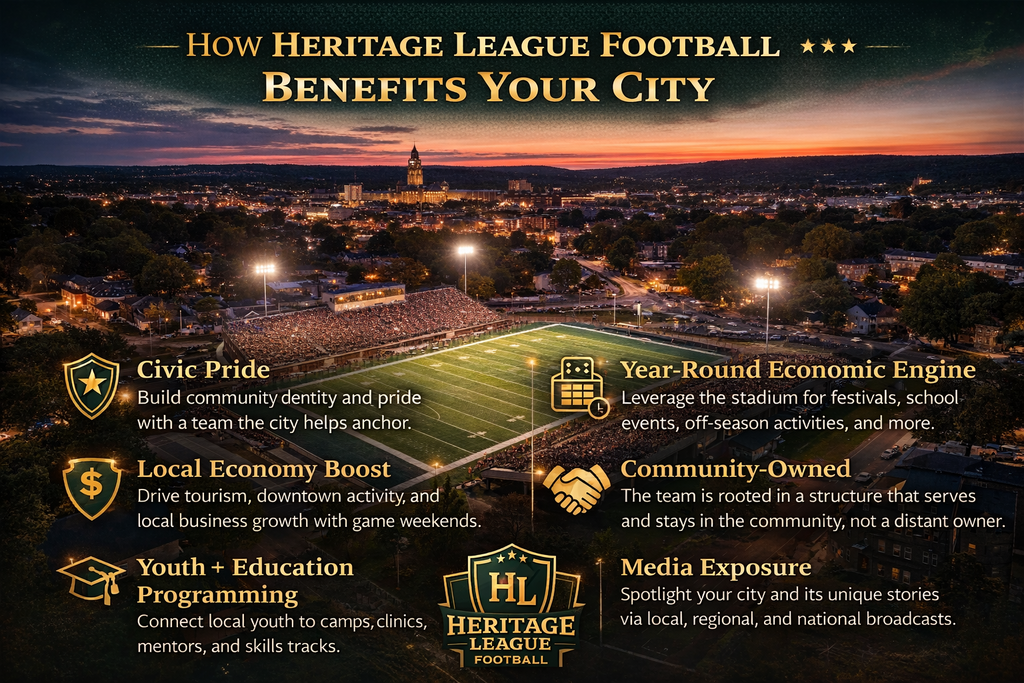
Heritage League Football is a community-owned, city-aligned pro sports model designed to generate year-round economic activity, civic pride, youth development pathways, and reliable media exposure — without handing your town’s future to an outside owner who can relocate.
This page is written for mayors, city managers, economic development directors, parks & recreation leaders, and council members who need a clear summary fast.
What the City gets
Structured municipal role, local economic activation, and a team that’s designed to stay rooted.
A city-aligned model with long-term protections.What the City is not asked to do
No blank-check stadium demand. No “trust me” owner. No relocation leverage games.
Everything is documented with controls.What this creates
Games + festivals + youth programming + local media + sponsor growth in one repeatable civic engine.
Year-round uses, not a once-a-week venue.What this is
This is a municipal-friendly pathway to secure a professional team while protecting the community from the classic problems: private extraction, opaque finances, and relocation risk. The league architecture is designed to be transparent, auditable, and repeatable across cities.
Core Idea
Every city team is built to operate as a local economic driver with structured governance, standardized controls, and a community ownership component that keeps the team aligned to the hometown.
- Local activation: vendors, festivals, tourism, local sponsors, regional broadcasts.
- Youth-to-pro ecosystem: camps, clinics, education partnerships, skills tracks.
- Media + programming: local content that scales to national visibility.
Why cities care
Cities get the brand lift and economic lift — while the model reduces the political risk of “one billionaire asks for everything.” The structure is designed so the community wins when the team wins.
- Anti-relocation orientation (team is rooted by design).
- Governance and finance controls (anti-embezzlement posture).
- Repeatable operations model (not reinvented every season).
City Position Options
The city can choose its level of participation. The goal is to keep this simple: your municipality understands what it is supporting, what it receives, and what it is accountable for.
| Option | City Role | What the City Receives | What the City Commits |
|---|---|---|---|
| A) Civic Partner |
Officially recognizes the project, appoints a liaison, aligns city departments where appropriate.
Best when the city wants a clean start without heavy commitments.
|
Priority city status, municipal partner branding, event alignment, public communications coordination. | Liaison appointment, reasonable coordination, access to venues/permits under standard municipal processes. |
| B) Venue + Operations Partner |
Works with us on venue pathing (existing stadium or staged upgrades) and event operations logistics.
Best when the city has an existing venue and wants controlled growth.
|
More event dates, structured tourism weekends, sponsor aggregation support, local programming slots. | Venue availability windows, operational coordination, defined services agreement (no blank checks). |
| C) Stewardship Stake Partner |
City takes a stewardship stake (policy-oriented) and participates in governance guardrails.
Best when the city wants strong protections and civic alignment.
|
Formal governance seat/voice for city protection, enhanced transparency access, community benefit covenants. | Documented stewardship terms, compliance posture, participation in oversight protocols. |
| D) Campus Ecosystem Partner |
Aligns long-term land use planning around a multi-use sports-and-community campus vision.
Best for cities seeking a long-term economic and education engine.
|
Year-round programming, training facilities, education ties, tournaments, festivals, media production. | Planning alignment, multi-year partnership roadmap, staged development terms (phased, measurable). |
Your city doesn’t need to pick the “biggest” option. Pick the one that matches your capacity and political reality. This is built to be phased.
What the City Gets
This is the practical list municipal leaders care about: dollars, jobs, tourism, youth programming, and reputation protection.
Recurring weekends that drive commerce
Game weekends become repeatable tourism weekends: hotels, restaurants, downtown traffic, vendor markets, local music, and sponsor activations — not just a single game.
- Local vendor lanes and artisan markets
- Festival-style tailgate zones
- Downtown after-hours activation
Youth pipeline + civic programming
The city gets a visible pathway: camps, clinics, mentoring, and skills programs that connect youth to coaching, production/media roles, operations roles, and athletics.
- Player/community service requirements
- School partnerships and mentorship
- Off-season clinics and events
Media presence that actually benefits the town
Cities benefit when broadcasts and local programming spotlight the community — landmarks, small businesses, local history, and civic identity.
- Local programming blocks
- Regional storylines and civic segments
- Community-owned narrative (not outsourced)
Reputation protection
The structure is designed to reduce scandal risk: financial controls, audit trails, and governance separation. Cities can’t afford to “partner blind.”
- Anti-embezzlement controls and checkpointing
- Segregation of authority (no one-person control)
- Transparency posture for qualifying voting stakeholders
Governance & Financial Safeguards
Cities want to know one thing: “Who controls the money and how do we know it won’t turn into a mess?” The operating structure is designed around separation of duties, auditability, and predictable controls.
Segregation of Authority
Four lanes of responsibility to prevent single-point abuse: Strategic, Oversight, Execution, Verification. No person should hold more than one lane.
- Documented approvals and audit trails
- Role-based access to banking and payouts
- Independent verification steps
Treasury Controls + Checkpointing
Designed for practical anti-embezzlement posture: an operating account with controlled access, plus a separate low-balance check-writing account funded as needed. Deposits that replenish trigger a review checkpoint.
- Centralized payment source wherever possible
- Dual authorization for disbursements
- Bank statement review + anomaly checks
If your city requires specific procurement language, bonding, or vendor compliance, we align the operating agreement to match your procurement reality.
What We Need From a City
This is the “get real” list. If a city can cover these basics, a team is viable.
Minimum municipal alignment
- One designated city liaison (single point of contact)
- Clear venue plan (existing or phased)
- Standard permitting/event coordination access
- Basic public safety and operations coordination
Venue realities
- Field-quality and safety standards
- Game-day operations plan (traffic, EMS, security)
- Defined use schedule (not “when we feel like it”)
- Phased improvements only where needed
Pathway to Securing a Team
A city partnership should not be vague. This is a straight path with milestones.
Phase 1 — City Discovery
- Intro call (city leadership + project team)
- Venue + operations feasibility review
- Community readiness scan (sponsors, fan base, partners)
- Draft city partnership option selected (A–D)
Phase 2 — Documentation
- Municipal packet delivered (terms, roles, safeguards)
- Draft MOU / partnership agreement path
- Governance + finance controls alignment
- Public messaging plan (when city is ready)
Phase 3 — Activation
- Local partner onboarding (vendors, sponsors, schools)
- Programming schedule (events + off-season uses)
- Operations team formation + staffing
- Team branding + local rollout
Phase 4 — Launch
- Preseason community events
- Season kickoff weekend activation
- Media programming cadence
- Ongoing oversight + transparency reporting cadence
Municipal FAQ
The questions your council will ask — answered cleanly.
Is the city buying the team?
Not by default. The city can choose a civic role, a venue role, or a stewardship role. The model is built so the city can participate without becoming the bankroll.
What stops relocation?
The structure is designed around local alignment, governance controls, and anti-extraction posture. The core point is: no outside owner gets to use relocation threats to squeeze the city.
Are we being asked for a new stadium?
No blank-check demand. The venue plan is staged: use what exists where feasible, upgrade only where needed, and document every step. Cities can choose the partnership level that matches their capacity.
How do finances stay clean?
Separation of authority, audit trails, controlled disbursement rules, checkpointing on replenishments, and an anti-embezzlement posture baked into operations. If your city requires extra compliance controls, we align to them.
What does the city get that’s tangible?
Recurring weekends that drive commerce, youth programming and clinics, city spotlighting through media, sponsor aggregation, and a civic-aligned team identity that stays rooted.
Municipal Contact
If you’re a municipality evaluating a team, use this form to request the municipal packet and schedule a call. If you prefer direct contact, email Don@Macon.One or call 828-634-1090.
Request the Municipal Packet
What you’ll receive
A clean municipal packet you can hand to council and staff: partnership options, controls, operating posture, venue pathway, and a clear explanation of city benefit.
- City role definitions (A–D)
- Finance & governance safeguards summary
- Venue and operations pathway checklist
- Program calendar concepts (games + civic events)
- Next-step scheduling instructions
Domain note: This page is intended to live on your league site (example: hl.football) as the single “municipal landing page” you send to cities.